
The Extraordinary Pilgrimage of Monsieur Kent LeFredge
From Helsinki to Molsheim—On Foot, In Pride, and Occasionally By Questionable Means
It is not uncommon, in the annals of motor racing, for a gentleman to lose a wager. It is considerably less common for him to pay it in such a manner as to alarm three nations, confuse two customs authorities, and ruin at least four pairs of borrowed socks.
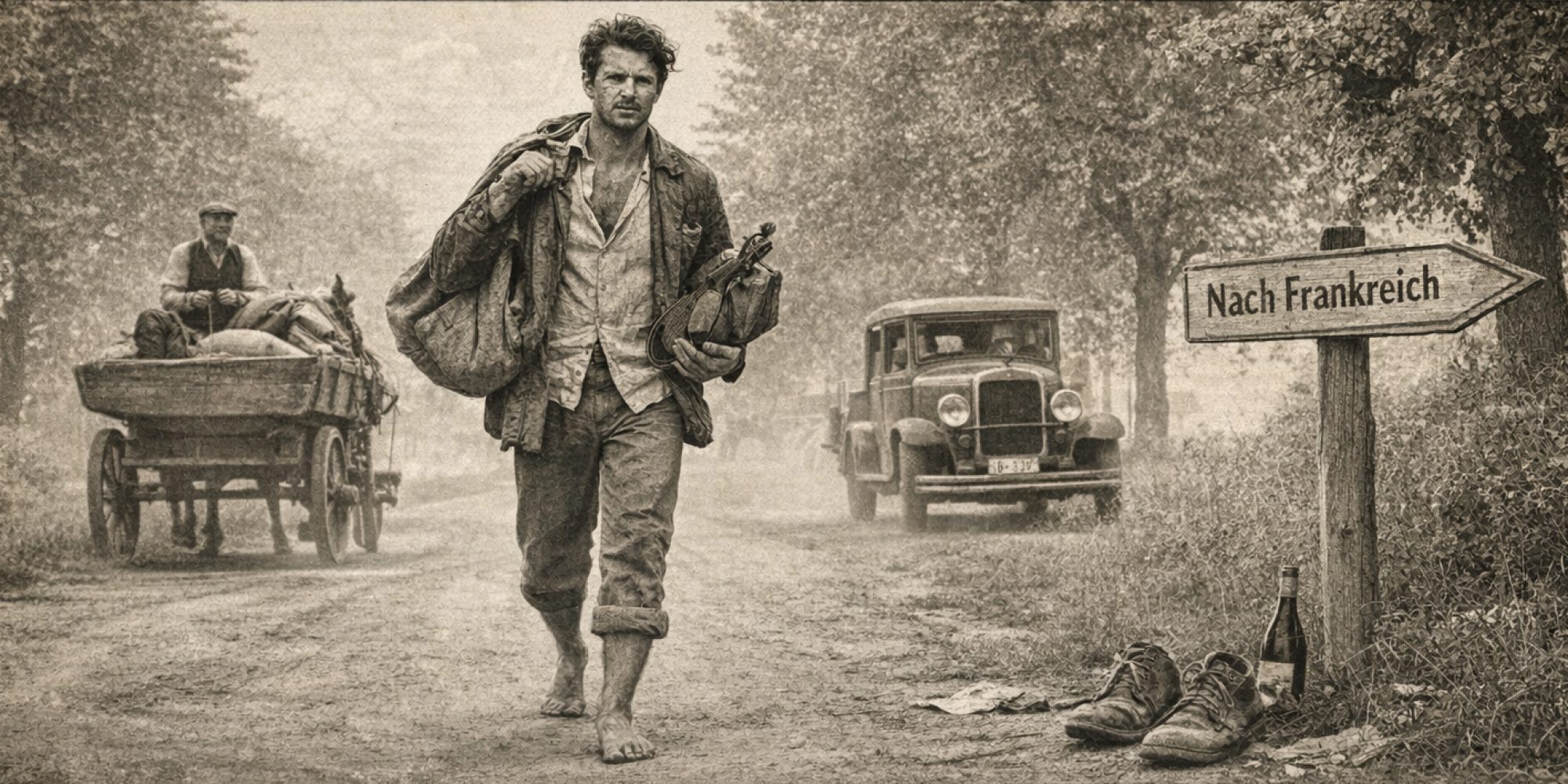
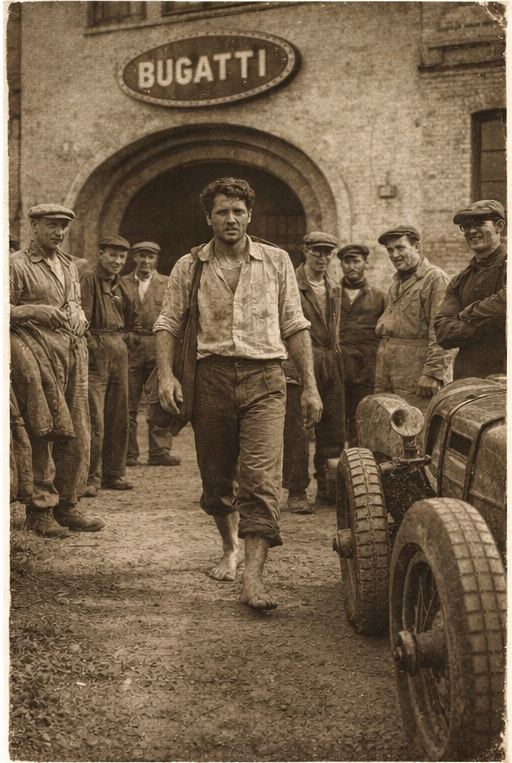
Such, however, is the case of Monsieur Kent LeFredge, late of Bugatti T39 fame, who, having failed to qualify from the heats at the recent Eläintarhanajot in Helsinki, found himself obliged—by a wager uttered, as witnesses attest, “with confidence bordering upon poetry”—to return barefoot to the Bugatti works at Molsheim.
A PROMISE KEPT, IF POORLY PLANNED
Motor racing, as history has shown, is no stranger to dramatic reversals, nor to heroic excess; yet even in a sport accustomed to daring feats and questionable judgment, Monsieur LeFredge’s enterprise must be considered exceptional.
His Bugatti, it seems, declined to continue in the heat race with a most uncooperative disposition, leaving its driver stranded not only from the final but from footwear.
Witnesses report that Monsieur LeFredge, after a brief but eloquent address to the Finnish sky, removed his shoes with ceremony, handed them to a startled mechanic, and began walking south with what one observer described as “the air of a man determined to regret something for a very long time.”
ESTONIA: HITCHHIKING, WITH DIGNITY
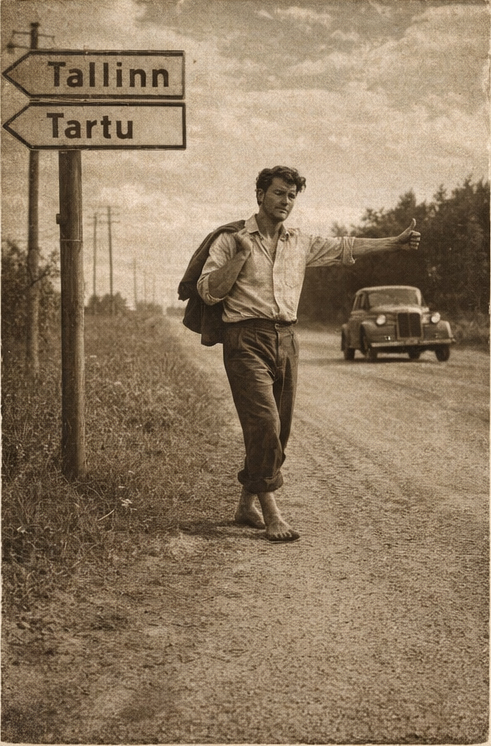
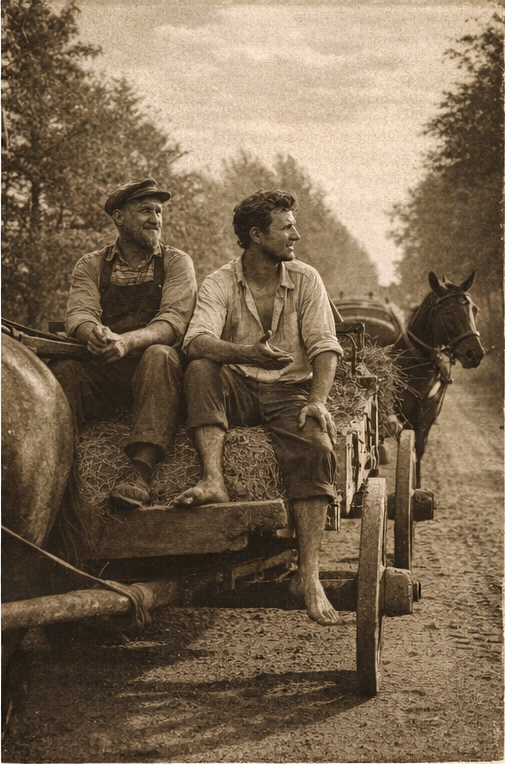
In Estonia, the Frenchman was seen attempting to “supplement” his vow through what he termed “mechanical assistance of a temporary nature.” This took the form of hitchhiking—always barefoot, it must be stressed, though occasionally seated in the rear of agricultural vehicles of uncertain origin.
One Estonian farmer is quoted as saying:
“He insisted he was not cheating. He said the feet must suffer, not necessarily the calendar.”
Reports indicate he was offered boots on several occasions, all of which he declined with great seriousness, though he did accept a wool blanket, two onions, and, inexplicably, a violin.
POLAND: THE WAR AGAINST HIS OWN CALVES
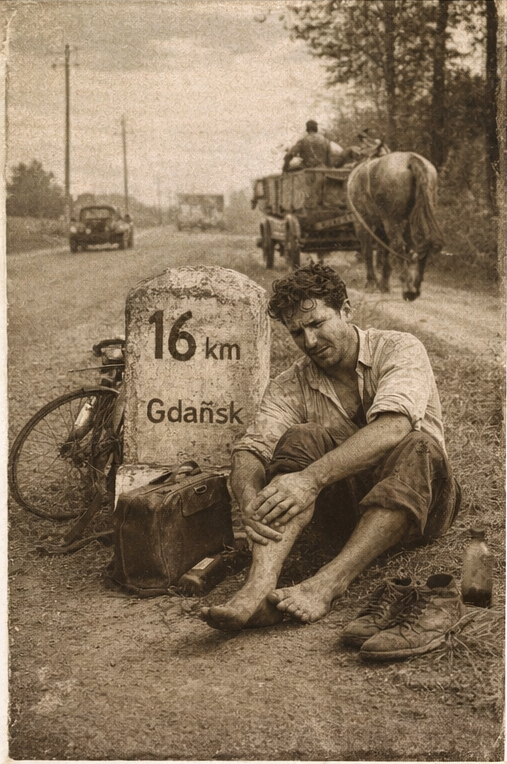
By the time he reached Poland, the tone of the journey had changed. Gone was the romantic adventurer; in his place stood a man engaged in an increasingly bitter dispute with his own legs.
Numerous villagers recall hearing French curses of considerable inventiveness echoing along the roads. One particularly vivid account speaks of LeFredge attempting to negotiate with his calves “as if they were independent contractors.”
At one point, he reportedly declared:
“The Germans may build fine engines, but it is my legs that will destroy me!”
GERMANY: PHILOSOPHY AND SAUSAGES
Crossing into Germany, Monsieur LeFredge adopted a more contemplative approach, perhaps forced upon him by exhaustion. He was observed seated by the roadside, lecturing a group of disinterested geese on the subject of “mechanical loyalty.”
In Stuttgart, a sympathetic innkeeper allowed him to rest—on condition that he cease comparing his feet to worn tyres in the dining room.
THE FINAL APPROACH: ALSACE AND DESTINY
At last, after 2,372 kilometres of increasingly questionable life decisions, LeFredge arrived in Molsheim. His feet, according to local witnesses, resembled “something between archaeological artefacts and abstract sculpture.”
The Bugatti factory workers, initially convinced they were witnessing a ghost, eventually admitted him—though not before one foreman reportedly asked:
“Have you come for work, or revenge?”
A HOMELESS HERO (OR SOMETHING CLOSE TO IT)
Alas, the journey’s conclusion was not without complication.
Believed dead after weeks of silence, Monsieur LeFredge discovered that his flat had been sold, his belongings dispersed, and—most troubling of all—his wife had attempted to sell his Bugatti T39.
What followed has been described, with admirable restraint, as “a discussion conducted in the spirited manner of the decade.” Details remain scarce, though neighbours confirm raised voices, a thrown baguette, and a final agreement of some kind.
The Bugatti, we are pleased to report, remains unsold.
WHAT NEXT FOR MONSIEUR LEFREDGE?
As of this writing, the question remains: will Kent LeFredge appear at next Sunday’s II British Empire Trophy?
Opinions are divided.
Some claim he is already in training, walking in circles to rebuild what remains of his dignity. Others insist he has sworn off wagers entirely, though this has been denied by those who know him best.
One factory mechanic offered a final, perhaps definitive assessment:
“If the car starts, he will race. If it does not, he will probably walk again.”
In the long history of motor racing—filled with speed, courage, and occasional folly—it is difficult to recall a story quite like this. Yet, as one is reminded, the sport has always belonged not merely to machines, but to men of peculiar determination.
And, in the case of Monsieur LeFredge, to their feet.