
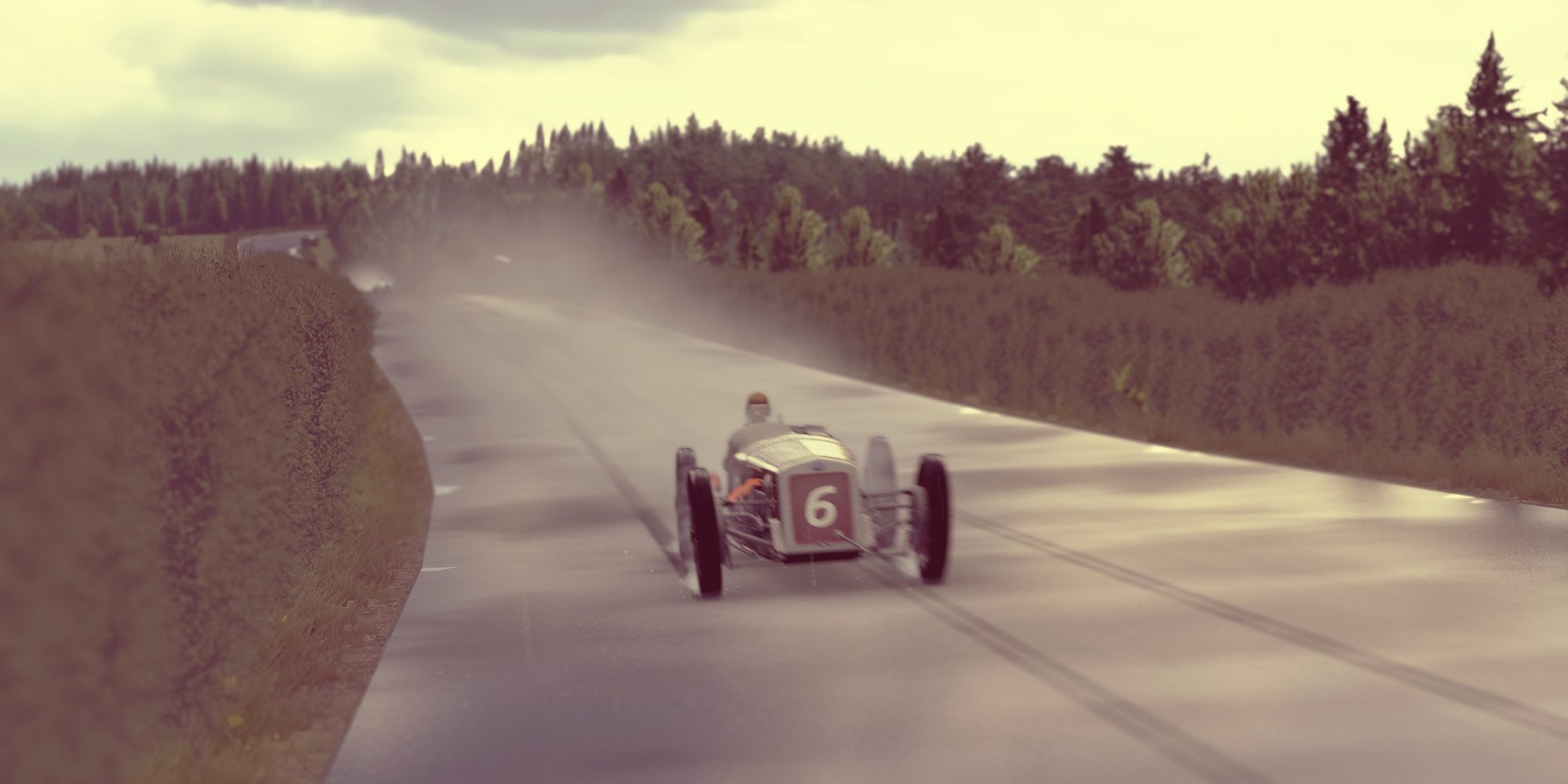
Setup guide and operating manual for interwar cars
For Grand Prix, Voiturette and Sports Cars (1920–1939)
“Speed is nothing without stability.”
— Tazio Nuvolari
These machines are not modern racecars. They were built for public roads, endurance, and bravery — not lap times. The aim of setup is not peak cornering grip but balance, predictability, and keeping the car alive for the full distance.
| Adjustment | Affects Mainly | Typical Safe Range |
|---|---|---|
| Toe | Steering response & straight-line stability | 0 to 1 mm toe-in per side |
| Camber | Tyre grip & wear | –0.5° to –1.5° |
| Bump | Ride harshness over bumps | Soft to medium |
| Rebound | Settling after bumps | Medium |
| Brake Bias | Stability under braking | 60–70 % front |
| Final Drive | Acceleration vs. top speed | Adjust per circuit (see below) |
1. Toe Angles
Definition: Direction the wheels point relative to the car’s centerline.
- Toe-in = front edges closer together.
→ Improves straight-line stability, but slower steering response. - Toe-out = front edges farther apart.
→ Quicker turn-in, but nervous on straights.
Tips
- These cars benefit from a touch of toe-in — about 0.5–1 mm per side.
- Avoid toe-out: narrow tyres and steering free-play make cars wander badly.
- If the car drifts or darts under braking → increase toe-in slightly.
- Rear toe: keep neutral or slightly inwards for stability.
Symptom Table
| Symptom | Likely Cause | Fix |
|---|---|---|
| Outer tyre overheating, understeer | Too little negative camber | Add a bit more negative |
| Inner tyre overheating | Too much negative camber | Reduce camber |
2. Camber Angles
Definition: Tilt of the wheel viewed from the front.
- Negative camber (top inward) = more corner grip, less straight-line contact.
- Positive camber (top outward) = stable on straights, poor cornering.
Tips
- Interwar tyres were tall and flexible — too much negative camber overheats the inner tread.
- Aim for –0.5° to –1.5° front, slightly less at rear.
- Keep both sides equal unless the circuit turns one way (e.g. Brooklands).
Symptom Table
| Symptom | Likely Cause | Fix |
|---|---|---|
| Outer tyre overheating, understeer | Too little negative camber | Add a bit more negative |
| Inner tyre overheating | Too much negative camber | Reduce camber |
3. Bump (Compression) Damping
Definition: Resistance as the suspension compresses over bumps or during braking.
- Higher bump = sharper response but harsh ride; may skip on rough roads.
- Lower bump = smoother but can wallow.
Tips
- Circuits were bumpy; start soft.
- Increase bump only if the car bottoms out too easily or bounces several times.
- If the car hops mid-corner, reduce bump slightly.
Typical Range: Soft to medium — don’t chase kart-like precision; chase composure.
4. Rebound Damping
Definition: Resistance as the suspension extends again after a bump or weight transfer.
- Higher rebound = car settles faster but can “pack down.”
- Lower rebound = freer movement, but may oscillate.
Tips
- Adjust so the car takes one bounce and then settles.
- If rear feels light after kerbs or braking → add rear rebound.
- If front stays low too long after braking → soften front rebound.
Symptom Table
| Symptom | Likely Cause | Fix |
|---|---|---|
| Car oscillates over bumps | Too little rebound | Increase rebound |
| Rear feels stiff or skips | Too much rebound | Decrease rebound |
5. Brake Bias
Definition: How braking force is split between front and rear.
- More front bias → stable but longer stopping distance, understeer.
- More rear bias → rotates the car but risks spin.
Tips
- Period cars had mechanical brakes; bias was fixed per axle.
- Start around 65 % front, adjust slightly forward for wet or downhill tracks.
- If the front locks early → move bias rearward a little.
- If the rear locks (car over-rotates under braking) → shift bias forward.
Symptom Table
| Symptom | Likely Cause | Fix |
|---|---|---|
| Rear steps out under braking | Too much rear bias | Move forward |
| Front slides straight on | Too much front bias | Move rearward slightly |
6. Final Drive (Gearing)
Definition: Determines acceleration vs. top speed.
- Shorter ratio (higher number) → faster acceleration, lower top speed.
- Longer ratio (lower number) → slower acceleration, higher top speed.
Tips
- Choose gearing so the engine reaches near-redline on the longest straight.
- On tight tracks (Monaco, Montenero): use shorter final drive.
- On fast circuits (Monza, Tripoli, Avus): use longer final drive.
- Don’t over-rev; early engines lost power (and con-rods) above safe rpm.
Symptom Table
| Symptom | Likely Cause | Fix |
|---|---|---|
| Car hits limiter halfway down straight | Gearing too short | Lengthen final drive |
| Car never reaches peak rpm even in slipstream | Gearing too long | Shorten final drive |
General Setup Philosophy
| Goal | Interwar Cars Require |
|---|---|
| Corner speed | Smooth steering, gentle inputs — no abrupt moves |
| Stability | Slight understeer is safer than oversteer |
| Endurance | Soft suspension and moderate camber save tyres and components |
| Driver comfort | The fastest driver is the one who can finish the race |
Typical “Good Baseline”
| Parameter | Value |
|---|---|
| Front toe | +0.00010 to +0.00020 (m) |
| Rear toe | 0.00000 to +0.00010 (m) |
| Front camber | –1.0° |
| Rear camber | –0.5° |
| Brake bias | 65 % front |
| Damper balance | Slightly stiffer front bump / softer rear rebound |
Practical Testing Routine
- Drive with full race fuel — weight changes balance.
- Do a 5-lap run — note tyre wear and temperatures.
- Adjust one setting at a time — small steps only.
- Test on bumpy section — smoothness beats stiffness.
- Don’t copy modern setups — these cars dance, they don’t grip.
7. Radiator Shutter Management
Controls: Extra E = Close | Extra F = Open (loops through 5 positions)
Positions: Fully Open → ¼ Closed → ½ Closed → ¾ Closed → Almost Closed
Purpose
Most interwar cars used adjustable radiator shutters to regulate engine temperature and aerodynamic drag.
An open shutter cools better but adds wind resistance.
A closed shutter reduces drag and raises engine temperature — which can mean more speed on straights, but danger if left closed too long.
How It Works
| Position | Cooling Efficiency | Aerodynamic Drag | Typical Use |
|---|---|---|---|
| Fully Open | 100 % | High | For warm-up laps, traffic, or steep climbs. |
| ¼ Closed | ~85 % | Medium-high | Normal race use on hot circuits. |
| ½ Closed | ~70 % | Medium | For long straights or moderate weather. |
| ¾ Closed | ~55 % | Low-medium | Cool-weather sprints or qualifying. |
| Almost Closed | ~40 % | Low | Short bursts of maximum speed or final laps. |
In-Race Strategy
- Start & Formation Lap
- Keep Fully Open to avoid overheating while idling.
- Check that coolant temperature begins rising normally.
- Opening Laps
- As speed builds and airflow increases, move to ¼ Closed or ½ Closed.
- Watch temperatures stabilise around your car’s ideal (usually under 80 °C).
- Long Straights / High-Speed Sections
- Briefly go ¾ Closed or Almost Closed to reduce drag.
- Re-open before braking zones or slower sections to restore airflow.
- On fast circuits (Tripoli, Monza, AVUS) this can gain several km/h.
- Traffic or Mountain Sections
- Open further when following another car closely or climbing hills where speeds — and airflow — are low.
- Late Race / Cool Weather
- You can safely run ¾ Closed for long stretches if ambient temperatures are low.
- Always re-open before slowing after the finish line; the sudden stop in airflow can spike coolant temps quite fast.
Warnings
- Never start the race with shutters closed. Engines will overheat fast.
- If you see steam or rising water temperature, open immediately — cooling recovery takes time.
- Don’t “pump” the shutters rapidly; in Assetto Corsa that can cause lag in temperature response.
- Remember that closing shutters slightly improves top speed but also lengthens braking (less drag).
Paddock Tips
- Treat the radiator lever like a throttle: small, deliberate changes rather than constant fiddling.
- Most drivers find ¼ Closed their safe all-round position.
- Learn the circuit’s temperature rhythm — open before climbs, close before long straights.
- On endurance events, monitor the gauge every few laps; engines fade when run too cold or boil when too hot.
8. Brake Duct Setup
Adjustment Range:
1 = Fully Open 2 = ¾ Open 3 = ½ Open 4 = Minimal Cooling (almost closed)
Adjustable only in setup menu — not during race.
Purpose
Brake ducts control how much cooling air reaches the drums.
Open ducts keep temperatures low and brakes consistent, but increase aerodynamic drag.
Closed ducts reduce drag and warm the brakes faster — useful on short or cool circuits — but risk fade on long, heavy stops.
Since most interwar cars used mechanical drum brakes with limited airflow, correct duct choice can decide whether you stop precisely or run out of pedal by mid-race.
How It Works
| Setting | Cooling Efficiency | Drag | Typical Use |
|---|---|---|---|
| 1 – Fully Open | Maximum | Slightly higher | Long races, hot weather, heavy braking circuits (Nürburgring, Pescara). |
| 2 – ¾ Open | High | Moderate | Good general-purpose balance for most road circuits. |
| 3 – ½ Open | Medium | Low | Cold weather or short sprint events. |
| 4 – Minimal Cooling | Low | Minimal | Very short races or high-speed tracks with few heavy stops (Monza, Tripoli). |
Choosing the Right Setting
- Consider Race Length & Weather
- Endurance races (1 hr +) → Open more to prevent fade.
- Short heats or qualifying → Close more for quicker warm-up and less drag.
- Match to Circuit Character
- Many slow corners or descents → higher cooling.
- High-speed ovals or long straights → smaller openings often sufficient.
- Use Practice Laps
- Watch brake temperature gauges (or feel pedal firmness).
- After 3–4 laps the pedal should stay consistent; if it hardens, ducts too open (too cold).
- If it softens or travel increases, ducts too closed (too hot).
- Plan for Race Pace, Not Qualifying
- Qualifying setups can afford warmer brakes.
- For full-distance events, set ducts one step more open than ideal lap pace.
Warnings
- Over-cooled brakes lose friction; cold linings “glaze” and stopping distance increases.
- Over-heated drums expand, giving long pedal travel or total fade.
- Cooling recovery is slow — once faded, brakes may not return to full strength for several laps.
- Each step tighter slightly reduces drag — but braking confidence is worth more than 1 km/h on the straight.
Paddock Tips
- Choose conservatively: it’s easier to drive with slightly cool brakes than with faded ones.
- If the circuit has long downhill sections (Bremgarten, Montenero), always prefer 1 or 2.
- Keep ducts consistent between left and right; uneven cooling can cause brake pull.
- In wet races, one step more open helps dry the drums faster after puddles.
9. Fuel Mixture Management
Controls: Engine Map button — cycles through 4 positions
Positions: Rich → Normal → Lean → Push → (loops back to Rich)
Purpose
The mixture lever adjusts how much fuel the engine receives compared to air.
In early supercharged and carburetted engines, this control was used constantly to balance power, fuel economy, and reliability.
In the sim, it affects power output, fuel consumption, and engine temperature — and therefore your race strategy.
Mixture Modes
| Setting | Power Output | Fuel Use | Engine Heat | Typical Use |
|---|---|---|---|---|
| Rich | Moderate | High | Cool | Safe during long stints, poor fuel mileage. |
| Normal | Standard | Normal | Balanced | Default for steady race pace. |
| Lean | Reduced | Low | Slightly warmer | For saving fuel in endurance or safety car periods. |
| Push | Maximum | Very High | Hot | Short bursts for overtaking or qualifying laps. |
In-Race Strategy
- Start & Early Laps
- Use Rich while the engine warms up and traffic is heavy.
- Switch to Normal once water temperatures are stable.
- During the Race
- Keep Normal for most laps — it gives good power with safe fuel use.
- Switch to Lean if your projected fuel load is tight or if running alone with no immediate pressure.
- Avoid prolonged “Lean” running in very hot conditions — it increases combustion temperature and can harm the engine.
- Overtakes & Hot Laps
- Engage Push briefly when you need maximum acceleration (e.g., drafting and passing, qualifying).
- Return to Normal immediately after — “Push” quickly raises engine temps and drains the tank.
- End of Stint / Final Laps
- If you have spare fuel, use Push in the closing laps.
- If low on fuel, switch to Lean and short-shift to make it home.
Warnings
- Running “Push” too long can overheat and damage the engine.
- Running “Lean” too long in high load or uphill sections can cause misfire or power loss.
- Always re-check radiator setting when changing mixture — richer settings cool, leaner ones run hotter.
Paddock Tips
- Think of mixture as race management, not performance tuning.
- Plan your fuel load and mixture together: for long events, start in Normal, finish in Push if you have reserves.
- Pair Lean + open radiator for fuel saving in heat, or Push + closed radiator for short qualifying bursts.
- If you suspect engine wear or overheating, drop to Rich immediately to cool it.
- Remember: you win long races by outlasting, not out-revving.
As these cars also have pretty primitive fuel tanks, the fuel feed is easily disrupted. Most notably when fuel tank gets empty (just about 20-30 litres of fuel left, depending on car) the long fast corners can start to cut the fuel flow to the carburetor, so it’s advised to put a little more fuel to the tank than simple the finihing race would require. That will still probably be faster as you have constant fuel feed. You can also save fuel by short shifting, coasting and using lean fuel mixture.
10. Supercharger Use (Mercedes-Benz SSKL only)
Control: Extra D = Toggle Supercharger On/Off
Purpose
The SSKL’s Roots-type Kompressor (supercharger) provides a large boost in power by forcing additional air into the cylinders.
Unlike earlier S, SS, and SSK models — where the supercharger engaged automatically at full throttle — the 1931 SSKL introduced a manual clutch system, allowing the driver to choose when to run the engine naturally aspirated and when to engage boost.
This reflected period practice: during endurance races, drivers conserved both fuel and machinery by cruising with the blower disengaged, saving it for overtakes, climbs, or timed laps.
Behaviour Summary
| Mode | Power | Fuel Use | Engine Heat | Typical Use |
|---|---|---|---|---|
| Off (Naturally Aspirated) | Normal (~200–220 hp) | Normal | Moderate | Cruising, steady race pace, conserving fuel and engine. |
| On (Supercharged) | Maximum (~300–350 hp) | High | Rapid rise | Overtaking, acceleration, or qualifying laps. |
In-Race Use
- Start & Early Laps
- Keep Off for warm-up and formation.
- Engage On briefly for the launch, then return to Off to settle temperatures.
- During the Race
- Use Off for most of the lap — the SSKL’s large displacement provides ample torque unblown.
- Switch On for short bursts:
- Long straights (e.g., AVUS, Tripoli).
- Uphill sections or to recover speed after corners.
- Passing manoeuvres or defending position.
- Disengage before braking zones or slow corners to reduce heat build-up.
- Qualifying or Final Laps
- If fuel and temps allow, run On for entire laps — but monitor gauges closely.
- Overheating will appear quickly, especially in hot weather or traffic.
Warnings
- Continuous use quickly overheats coolant and oil, risking power loss or mechanical failure.
- The sudden torque increase can spin the rear wheels on corner exit — apply throttle progressively.
- Avoid toggling rapidly; allow several seconds between engagements for the clutch to stabilise.
Paddock Tips
- Think of the Kompressor as a push-to-pass tool rather than a permanent mode.
- Typical safe usage: 5–10 seconds at a time, then at least half a lap of cooling.
- Combine Kompressor On with Push mixture for maximum performance bursts.
- Listen for the supercharger’s whine — when it rises sharply, watch your gauges.
- Real SSKL drivers, like Caracciola, used the blower sparingly: “A weapon for moments of need.”
11. Electricity system
If the car has battery, the lights use its capacity to be on. If the battery runs dry the lights go out. The battery is charged by dynamo which power is defined by current rpm and its condition (it can get damage from collisions). So when using the lights try to keep the rpms high to not drain the battery. Big bumps or hits can reduce battery’s capacity, so you need to drive smoothly.
Dynamo uses belt to charge the battery, but that belt can snap so you might need to pull over and change it on the side of the road by using Extra B. When it’s raining, the wet can also make the belt slip and therefore reduce the charging power. It can also slip totally of, so you need to repair that too by stopping and using Extra B.
Battery only cars (some had battery, but also magneto for ignition) will also stop running when the battery dies. So you would need to get into pits before that happens and repair it by pressing Extra B in the pitbox. Same repair procedure goes to dynamo. The ammeter in Dashboard app shows with the small dots if battery or dynamo are in good (green) or bad (orange or even red) shape.
12. Preselector gearbox
Controls: New gear → tap of Clutch
Some cars, like ERAs and Talbots used preselector gearboxes. They were easier to use at the time when normal manual were non-synchros.
Wilson type preselector works otherwise similarly than normal manual gearbox, but it won’t change the gear until you press the clutch a little. So you can drive on one gear and then change gear normally, but that won’t change the gear yet. Just when you press the clutch, the gear is changed instantly. This will prevent misshifts totally. But beware as they don’t have downshift protection still, so overrevving while slowing down is still possbile. You can use the preselector indicator on Dasboard app with these cars.
13. Non-synchromesh gearbox
Controls: Clutch → Neutral → Clutch → New gear
All other interwar era cars have traditional non-synchromesh gearbox that requires dual-clutching. Meaning that when you shift gears, you will first need to shift into neutral, release clutch and then shift into the new gear with clutch again. As that can be pretty demanding to learn and use consistently, the cars have that as an optional feature that is not in use by default, but you can select to use it from the setup (Use non-synchromesh gearbox setting).
14. Manually pressurized fuel tank
Controls: Extra G = Pump some air to the fuel tank
The fuel tanks and fuel feed for carburetor for interwar era were mostly gravity fed and to ease that the fuel tank needed to be pressurized by pumping air there. As that can get easily overwhelming to drivers, that feature is also set up as optional one, that you can use if you wish, but by default that is set to be automatic. On the other hand pre-1924 season drivers had riding co-mechanic onboard, whose responsibility it was to operate the fuel pressure pump, so setting that automatic on that era cars is even realistic. Also from about mid-30s onwards the teams started to use fuel pumps, that made the pressurizing obsolete. You can pump air to the tank by using Extra G button, when the setting is in manual. Failing to do so will cut the fuel feed to the angine and you will lose power and eventually stop the car. You can use the Fuel tank gauge on Dasboard app with these cars.
If fuel tank gets puncture, the pressure naturally can’t keep as well in the tank so you must hurry to the pits and patch it by repairing the body. Otherwise you will run out of fuel and ability to use it.
15. Manually managed oil pressure
Controls: Extra C = Pump some oil to the engine bay
In Edwardian era cars (made before WW1) the driver, or actually the riding co-mechanic, also operated the oil pump that fed the engine with oil and kept it lubricated. For such cars that is also optinal feature that you can enable in setup, if you wish to do so. You will then operate the oil pump by pushing Extra C while on track. If you let the oil run out the engine will start to run hotter and hotter and will start to get damage and eventually melt down. You can use the oil pressure gauge on Dasboard app with these cars.
Cars also have oil tanks now and the engine consumes some amount of fuel while driving. The higher the rpm, the more it consumes. The oil tank can get puncture on crashes, that depletes it faster. If the oil level is getting too low, you need to go to pits and repair body and also press Extra B to refill the oil tank. If you only run out of oil but the tank is okay, it’s enough to just refill it with Extra B.
Car owner’s manual in a nutshell
Here’s the complete car owner’s manual – what to do if shit happens:
- Stalled engine – Press
Extra Aas long as engine starts - Overheated water – slow down OR stop and wait it to cool down OR stop in pits to get water temps down to 80c
- Radiator damage – fix body
- Brake damage – fix body
- Brake fade – just drive more carefully, not fixable
- Spark plug failure – fix engine
- Valve problems – fix engine
- Oil pressure dropping – fix engine
- Gear failure – make a pitstop and Press
Extra B - Fuel pump problems – make a pitstop and Press
Extra B - Valve problems – fix engine
- Broken dynamo – make a pitstop and Press
Extra B - Broken battery – make a pitstop and Press
Extra B - Snapped or off-slipped dynamo belt – – stop and brake + pull
Extra Bfor 2 sec and wait - Blown tyre – IF you have spare wheels, stop and pull
Extra Bfor 5 sec and wait OR ELSE go to pits and change tyres normally - Leaking fuel tank – stop and brake + pull
Extra Bfor 2 sec and wait OR make a pitstop - Stuck in a ditch etc – Press
Extra Pfor so you will be pushed forward. Engage R to get pushed backwards. Or 1/2 to get pushed left/right
Also you have working gauges in the cockpit that are advised to keep on eye regularly during driving. The gauges are different on every car though (they are listed on a race page’s car info). Alternatively you an use CVR Dashboard app, CVR Companion app, CVR Pitboard app and GEC Car manual app to follow some info on the car. You can adjust some things from the cockpit also. Those are following:
- Toggle supercharger off/on – Press
Extra D(Only available at Mercedes SSKL) - Change radiator shutters – Press
Extra Eto close the shutters more ORExtra Fto open them more (usually not available in Voiturettes). - Change fuel mixture – Press
Engine mapbutton to cycle through them - Pump air to fuel tank – Press
Extra G - Pump oil to engine – Press
Extra Cwhile on track
These cars reward the patient and the precise. They move, roll, and breathe with the road. A well-set-up interwar car feels alive — it slides gently, talks through the steering, and forgives small mistakes. Drive it like a craftsman, not a warrior.